
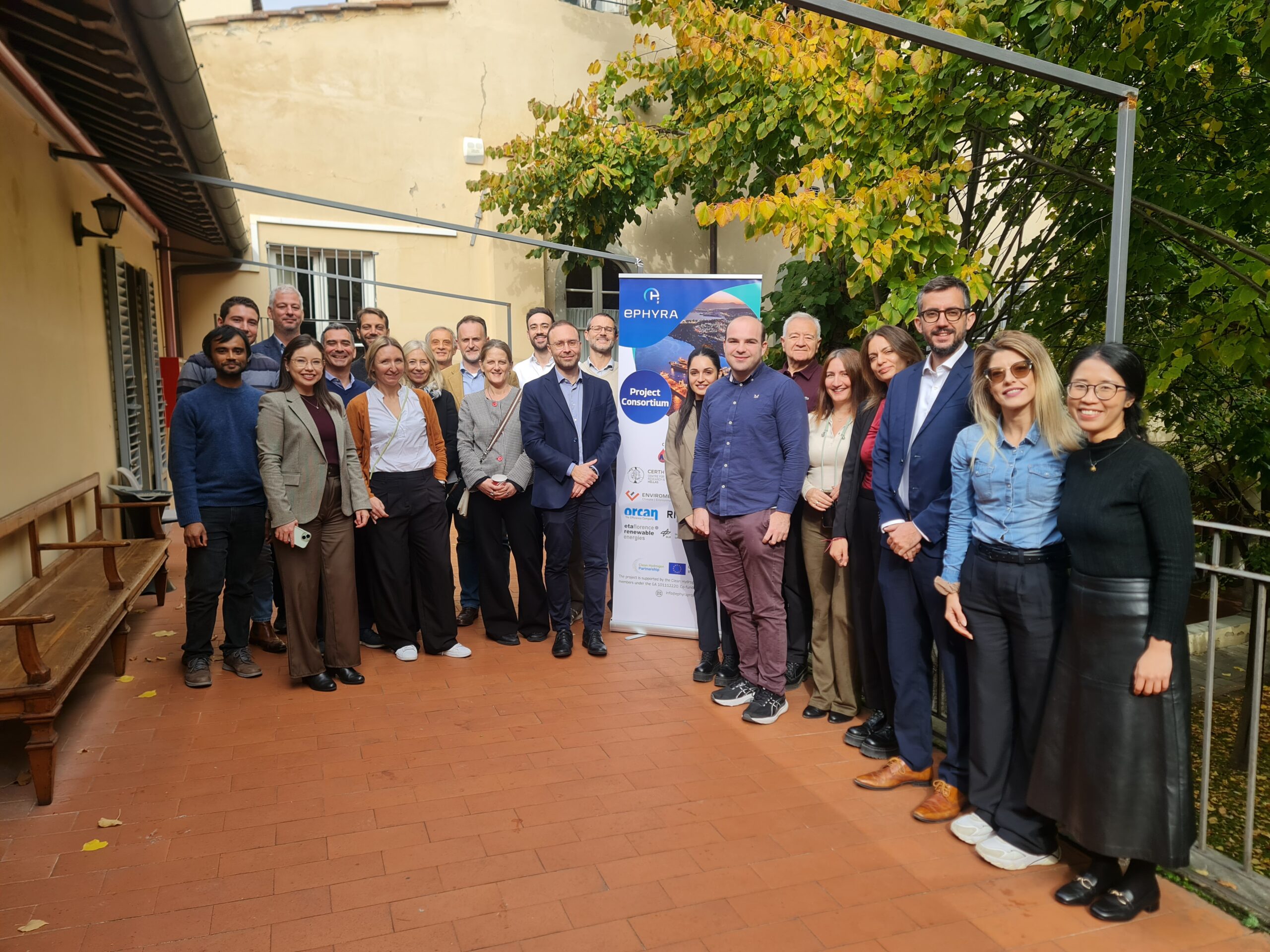
On 04-05 November 2026, the EPHYRA project consortium partners gathered in Florence, Italy for its 3rd General Assembly, to review three years of progress and align on the next steps towards industrial-scale green hydrogen production. Hosted in a hybrid format by ETA Florence Renewable Energies, the meeting provided an opportunity to exchange updates, assess key achievements and prepare for the project’s transition towards commissioning and operation.
With significant and ongoing progress across technology development, industrial integration, engineering and sustainability assessments, EPHYRA is moving closer to its ambition of establishing a 50 MW green hydrogen production facility at the Motor Oil Hellas (MOH) refinery in Agioi Theodoroi, Greece.
The 3rd year momentum: Key achievements and progresses
From technology development to industrial readiness
One of the major achievements since the previous General Assembly in Cottbus, Germany (May 2025) is the completion of the essential safety planning for the 50 MW electrolyser system. Comprehensive safety staties and risk assessments have been carried out to ensure the installation meets stringent industrial safety requirements e.g. SEVESO III Directive.
The project has also made substantial progress on regulatory approvals. The environmental permit amendment was approved in November 2025, while the installation approval process has been completed. The Hydrogen Producer Certificate was issued in June 2026, and preparations are now underway to obtain the final operating licence.
Meanwhile, the plot plan for the 50 MW electrolyser installation was finalised last year, providing the foundation for the project’s engineering and construction activities. Mechanical completion of the 50 MW system was realized in August 2026.
Efforts on turning waste into valuable resources
A central ambition of EPHYRA is to demonstrate how green hydrogen production can be better integrated into existing industrial operations through a circular economy approach. Rather than treating energy and material by-products as waste, the project explores opportunities to recover, reuse and maximise their value.
Significant progress was achieved during the previous period in assessing the internal use of oxygen generated during electrolysis within the MOH refinery, alongside innovative approaches to water management, including seawater desalination and wastewater reuse.
Another major development is the selection and ongoing engineering of an Organic Rankine Cycle (ORC) system, supplied by project partner ORCAN, to recover waste heat from the refinery’s medium-temperature diesel stream and convert it into electricity. The selected configuration offers a cost-effective and compact solution that fits the refinery’s operational requirements and project timeline. National Technical University of Athens economically assessed the integration of the ORC system with the electrolyser.
Digital innovation: The hydrogen plant is going virtually
EPHYRA has reached important milestones in developing its digital twin – a virtual representation of the hydrogen production facility that will help engineers understand, monitor and optimise how the integrated system operates.
The initial process model of the alkaline electrolyser has been completed, alongside the development of an optimisation framework to improve electrolyser performance and manage energy flows across the 50 MW system.
These tools will allow the project to explore different operating scenarios, improve the coordination between hydrogen production and the refinery’s energy requirements, and support more efficient plant operation once the facility becomes operational.
Moving closer to commissioning
The project has entered an advanced stage of engineering and installation. Following the completion of front-end engineering design, detailed engineering has progressed steadily since June 2025, with the main 50 MW installation reaching mechanical completion at the end of August 2026.
The remaining engineering activities focus on consolidating final technical specifications, operational requirements and safety documentation (i.e. PFD, P&ID, HAZOP and safety-study documentation package). Meanwhile, ORCAN’s ORC modules are expected to be delivered to the refinery site in November, with their integration and installation forming a key part of the next implementation phase expected in mid-2027.
Together, these developments mark an important transition from technology design and preparation towards the completion of the integrated industrial installation.
Building the business case and assessing long-term sustainability
Alongside technical development, EPHYRA continues to assess the economic, environmental and societal benefits of large-scale green hydrogen production.
Led by RINA and in collaboration with ENVIROMETRICS – two experts in techno-economic, environmental and societal sustainability assessments – the project has completed important market and business assessments. Following the upgrade from an initial 30 MW configuration to the current 50 MW system, the business plan has been updated accordingly. The latest financial assessment continues to indicate positive economic prospects, supported by a positive Net Present Value (NPV) and an Internal Rate of Return (IRR).
Currently the project is placing greater emphasis on evaluating the project’s environmental and socio-economic impacts, including a preliminary Life Cycle Assessment (LCA) to identify potential environmental hotspots and a broader assessment of impacts on workers, communities and other stakeholders throughout the project’s value chain.
Sharing knowledge and engaging with the scientific community
EPHYRA’s research and technical achievements have also gained visibility through international scientific events. In 2026, project findings were presented at the EPHyC – European PhD Hydrogen Conference, 15th Panhellenic Scientific Conference on Chemical Engineering, the 29th Conference on Process Integration, Modelling and Optimisation for Energy Saving and Pollution Reduction (PRES’26), and the 36th European Symposium on Computer Aided Process Engineering.
These contributions covered topics including waste heat valorization of an industrial scale electrolysis system, the optimisation of multi-stack alkaline electrolysers, mathematical modelling of energy allocation and strategies for improving the operation of renewable-powered hydrogen systems in industrial settings.
Through these exchanges, EPHYRA continues to strengthen knowledge transfer and contribute to the wider advancement of industrial green hydrogen technologies.
Full steam ahead – key milestones in 2027
With major engineering and technology milestones achieved, the consortium is now focused on completing the remaining installation and integration activities in preparation for the facility’s operation.
Looking ahead to 2027, key priorities include carrying out site acceptance testing, commissioning and completing the integration of ORCAN’s waste heat recovery modules and the installation of the associated heat exchangers.
The project is targeting the completion of key construction activities in the first quarter of 2027, followed by ORC integration in the second quarter. The monitored operation of the green hydrogen production unit is expected to begin in the third quarter of 2027.
As EPHYRA moves into this decisive implementation phase, partners remain committed to demonstrating how renewable hydrogen production, industrial energy integration and circular resource management can work together to accelerate industrial decarbonisation.
Stay connected with EPHYRA as we move closer to bringing large-scale green hydrogen production into industrial operation!